From 100-Year-Old Wine Tanks to Award-Winning Hotel
When Nikos Karaflos was 13, his history teacher assigned an essay about local industry. He chose the abandoned winery on Kourouta Beach, the one he'd passed his whole childhood. He interviewed former workers who described the rhythm of harvest seasons, how wine flowed through pipes directly onto ships, how the building guided their entire lives. The Currants Crisis of the 1910s had collapsed Greece's main export, forcing the country to convert unsold fruit into wine. This factory, built in the late 1920s by the Autonomous Currants Organization, stood literally on the sea so vessels could load directly from the production line. It ran until the early 1980s, then sat abandoned for two decades. In 2003, Karaflos's family bought it at auction. His father wanted demolition. Nikos, remembering those worker interviews and childhood walks past the concrete tanks, convinced him otherwise. He contacted K-Studio architects, who saw immediately what took a century to create. The aged concrete patina, the wine stains still visible on tank walls, the industrial scale built for bulk processing. They spent years analyzing layouts, preserving history, breathing new life without erasing what time had written. Today, 34 wine fermentation tanks hold 34 suites with sliding glass doors, timber screens, and terrazzo floors. The two steel silos host sound healing and wine tastings. The engine room serves hyperlocal Greek cuisine. The beach stretches endlessly. Just three hours from Athens, it's a place where industrial history meets Ionian sunsets, where you sleep inside concrete vessels that once held wine destined for distant markets.

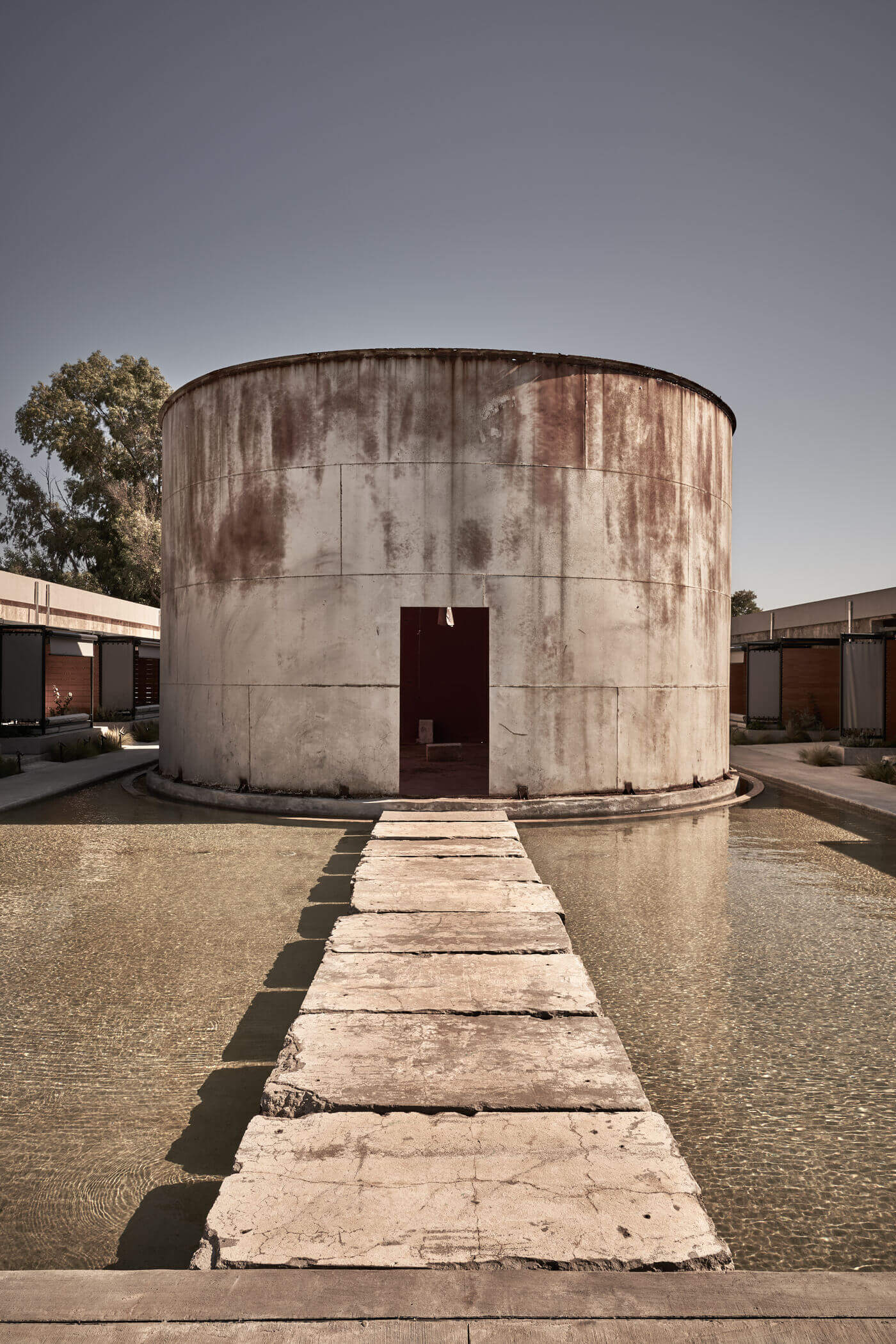
"I was 13 years old researching this winery for school. I interviewed the workers, heard their stories. Even then, I felt the energy of this place was extremely powerful. I imagined how it would feel to sleep in the tanks and wake up to see the sea first thing in the morning."
The restoration honored what a century had created. Dimitris Karampatakis and his brother Konstantinos from K-Studio walked the site and recognized the aged concrete as the most valuable material present. Its patina, formed through decades of salt air and weather, told the complete story. They designed every intervention around reuse. Concrete slabs removed to create doorways became stepping stones across the courtyard, coffee tables, chairs. Reclaimed bricks paved the restaurant floor. Old water pipelines transformed into handrails. The material palette stayed minimal: concrete, steel, engineered glass, timber chosen as reference to the region's nautical history. Polished terrazzo surfaces echo the colorful beach-pebble aggregates revealed when they cut window openings through tank walls. Nothing cleaned too much. Nothing selective about heritage. The wine stains remain visible inside certain tanks. The two massive steel silos still dominate the central courtyard, standing in shallow water accessible via concrete stepping stones. These once stored grape juice before transfer to fermentation tanks. Now they host sound baths, yoga sessions, art installations, private dinners under the stars. At Kourouta Beach, the industrial scale contrasts dramatically with the idyllic setting. That tension, that unexpected collision of brutalist architecture and endless golden sand, makes Dexamenes unlike anywhere else on Earth.

K-Studio's Dimitris Karampatakis describes the philosophy simply: "When we first arrived we saw something which took about a century to make. We didn't want to clean it too much, to be selective of its heritage. It was more important for us to embrace the whole story." Working with Nikos, they convinced his father that uniqueness itself held commodity value in a world of sameness. Every cut through concrete revealed beach-pebble aggregates that became terrazzo inspiration. The building was constructed for industrial scale, everything oversized for bulk wine production. That awkward proportion became the design's strength. Large sliding windows carved into tank walls open fully to sea air or close to retain cool darkness. Timber screens add warmth without competing with concrete's dominance. Textured glass walls separate bathrooms, allowing light to reach the back of each 30-square-meter tank. The imperfections, the stains, the roughness—all intentionally preserved.
Three hours from Athens, one hour forty from Kalamata Airport. Arriving at Kourouta Beach, the contrast hits immediately. Endless golden sand meets brutalist concrete. Thirty-four tank suites exist in three categories: Beachfront faces the Ionian directly, Courtyard overlooks the steel silos, Backyard offers maximum privacy. Each sleeps three with king bed and sofa bed. Larger groups book interconnecting tanks sleeping six, or the Beachfront Villa sleeping ten. The dex.Machina restaurant occupies the original engine room, serving hyperlocal seasonal ingredients from nearby farmers and fishermen. At dex.Lab bar, try the Herbal Elixir cocktail infused with Mediterranean herbs from the property's landscape. The two silos host sound healing sessions, contemporary art exhibitions, and curated wine tastings celebrating the region's viticulture revival. Ancient Olympia sits 45 minutes away. But most guests never leave the beach.

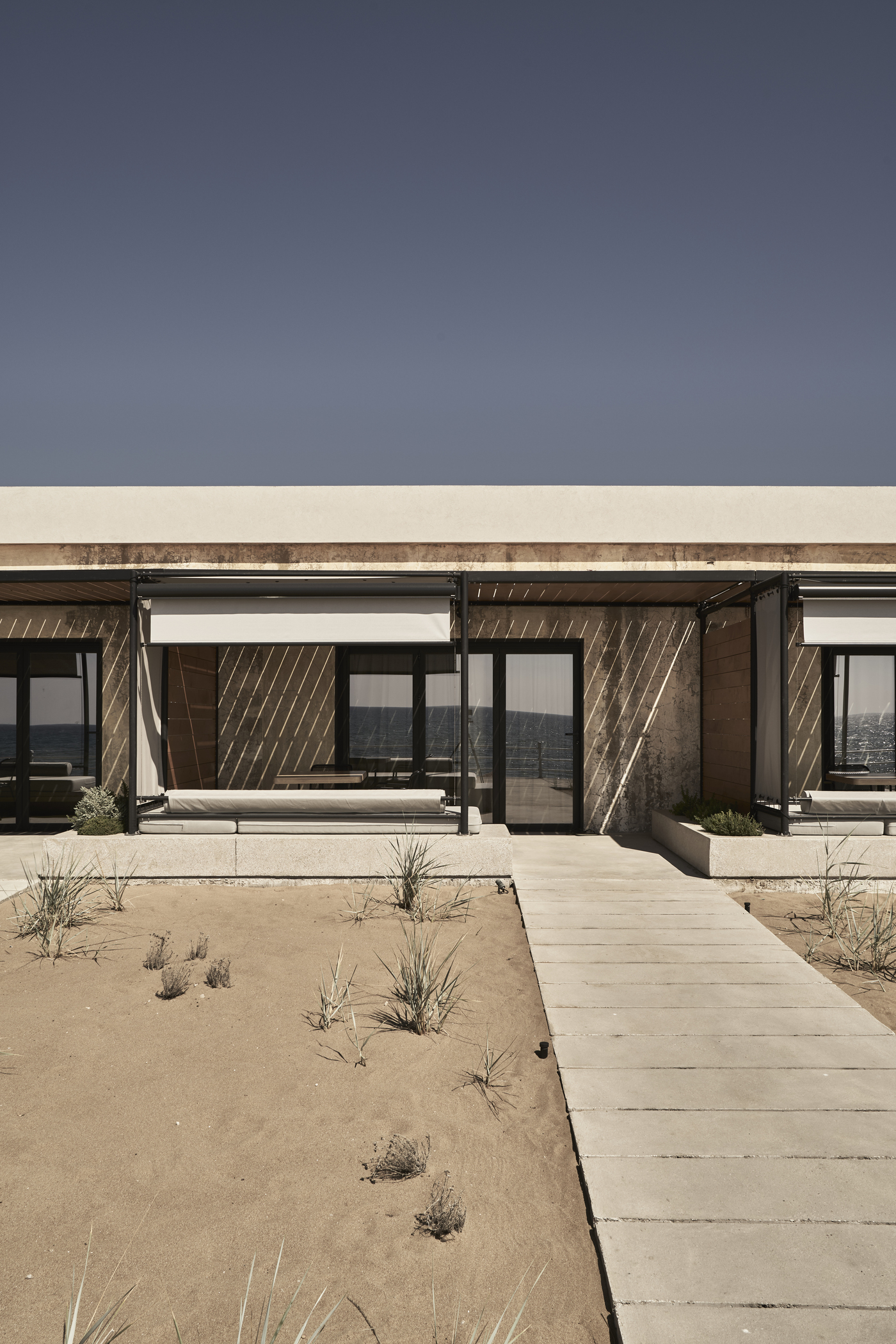
"The aged concrete was like gold—its patina, formed over a century, the most valuable material on site. We designed our cuts around how we'd reuse each piece."
Dexamenes received the AHEAD Global Awards 2021 Ultimate Winner designation alongside recognition from Design Hotels, Condé Nast Traveler's 2020 Hot List, and AHEAD Europe Awards for Best Suite. The project demonstrates how industrial heritage can inform contemporary hospitality without resorting to nostalgic reconstruction or historical erasure. Where economic crisis once drove production innovation, conscious travel principles now guide operational decisions. The Currants Crisis shaped this region's identity for generations. That narrative continues through adaptive reuse that honors labor, materiality, and place. Just three hours from Athens on the golden coast of the western Peloponnese, where wine once flowed to ships and now guests sleep inside the vessels that held it.

Why We Choose to Film
Dexemenes Seaside Hotel
Dexamenes was our first film, and that was not accidental.
It was the first place that made the philosophy clear. Not destroying what came before, but rebuilding with care. An abandoned winery on the edge of the Ionian Sea, left sealed for decades, carrying the memory of labour, agriculture, and a local economy that once depended on it. Most places like this are erased and replaced. Dexamenes was rebuilt by listening.
What drew us here was restraint. The decision to keep the tanks intact. To sleep inside them rather than disguise them. To treat concrete, stains, cracks, and scale not as flaws, but as history worth living with. What took nearly a century to form was revealed, not redesigned.
That same thinking extends beyond the architecture. The hotel does not sit apart from its surroundings, but works with them. Local farmers, fishermen, and producers are not supporting characters. They are the foundation. Ingredients come first, relationships come before menus, and the hotel exists in a way that keeps local life in motion rather than replacing it.
There is something deeply human in that approach. Respect for memory. For working life. For continuity. Dexamenes shows that progress does not have to mean starting again, and that travel can support a place rather than consume it.
As a first film, it set the direction. This would never be about spectacle or excess. It would be about places that already had a story, and the discipline to let that story remain visible.
Dexamenes was the beginning, because it showed what mattered most.