Beginning With Walking, Not Branding
Before any design decisions were made, before any architect was hired, before the first planning application was submitted, the project began with walking. Not surveying. Not market analysis. Walking.
Streets were traced and retraced. Buildings were studied. Corners were revisited at different times of day. The team behind the hotel, founded by Paul Brackley who previously served as managing director at The Beaumont in Mayfair, understood they were entering a neighbourhood with good reason to distrust hotel developers. Fitzrovia had watched what hotels did to Soho. They were not eager to repeat that story.
So the team walked. They learned who uses the streets in the morning. Where people stop for coffee. Which pubs fill up midweek rather than weekends. They studied not just the history of Fitzrovia, but its current rhythm. Its unspoken rules. Its careful balance between residential calm and creative energy.
The company behind The Newman, Kinsfolk & Co, was itself founded in Fitzrovia. That proximity matters when you are asking a neighbourhood to trust you with its first hotel. This was not an outside developer arriving with plans drawn elsewhere. This was a local team understanding that any hotel in Fitzrovia would need to justify its existence not to investors, but to the people who already lived here.
Director of Sales Alex Drowne explains the approach plainly. The management company walked the neighbourhood for weeks with design studio Lind + Almond, observing what makes Fitzrovia distinct from Mayfair's formality or Soho's chaos. They researched characters who lived here across different eras, understanding that Fitzrovia's identity was built by people, not brands.
Writers from the 1960s. Musicians like Paul McCartney and Jimi Hendrix who had flats nearby. Virginia Woolf who lived and worked here. Dylan Thomas who held court at the Fitzroy Tavern. George Orwell who wrote from these streets. Nancy Cunard, the poet, publisher and activist who became a fixture of 1920s bohemian Fitzrovia. Aleister Crowley, deeply involved in occultism and esotericism during the same era.
They also studied what exists now. Production companies. Creative agencies. Independent galleries beside Georgian townhouses. Michelin starred restaurants tucked into converted warehouses. A neighbourhood economy built on people who make things rather than people who consume luxury.
The challenge became clear. How do you build Fitzrovia's first proper hotel without destroying what made the neighbourhood resist hotels in the first place? The intention was clear from the beginning. We wanted to add to this area, Drowne says, not gentrify it. That distinction runs through every decision. Because in a neighbourhood that never wanted a hotel, getting it wrong meant immediate rejection.
Designed With the Street in Mind
In a neighbourhood suspicious of outside developers, every design decision became evidence. Would this hotel reference Fitzrovia's actual architecture, or import generic luxury references from elsewhere? Would it understand what makes this area distinct, or flatten it into interchangeable boutique hotel aesthetic?
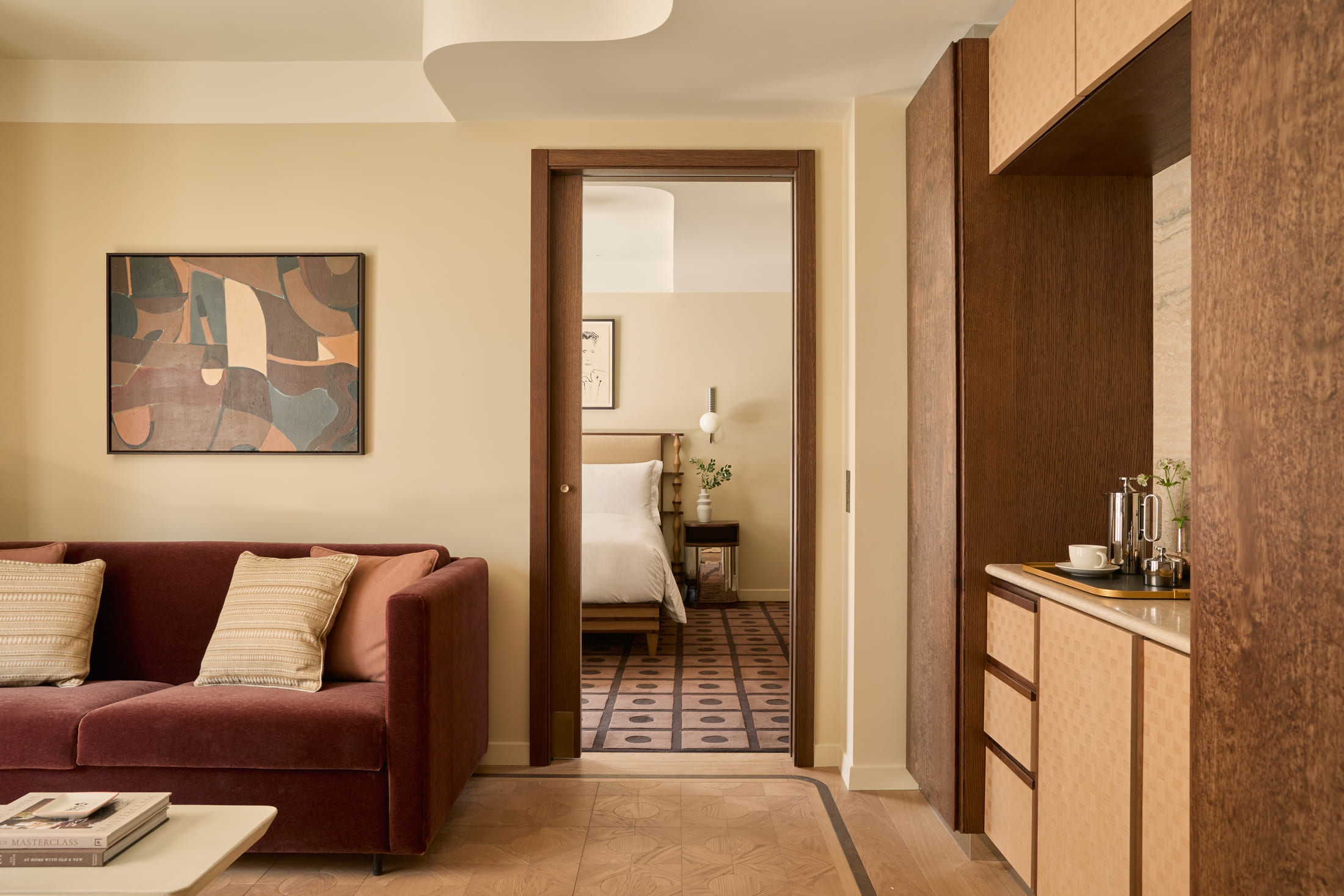
Design studio Lind + Almond, led by Pernille Lind and Richy Almond, responded with interiors that feel grounded rather than styled. Architectural references are drawn directly from the neighbourhood rather than imported trends. The bathroom vanities echo the curved proportions of balconies on Shropshire House, a striking Art Deco building just streets away. The curves are subtle enough to be felt rather than noticed, revealing themselves slowly as you use the space.
Tiling throughout the hotel borrows its geometry and rhythm from the Langham Court Hotel's distinctive checked façade, another local landmark. These are not generic Art Deco references pulled from a mood board. They are specific translations of buildings you can walk to from the hotel entrance in under three minutes.
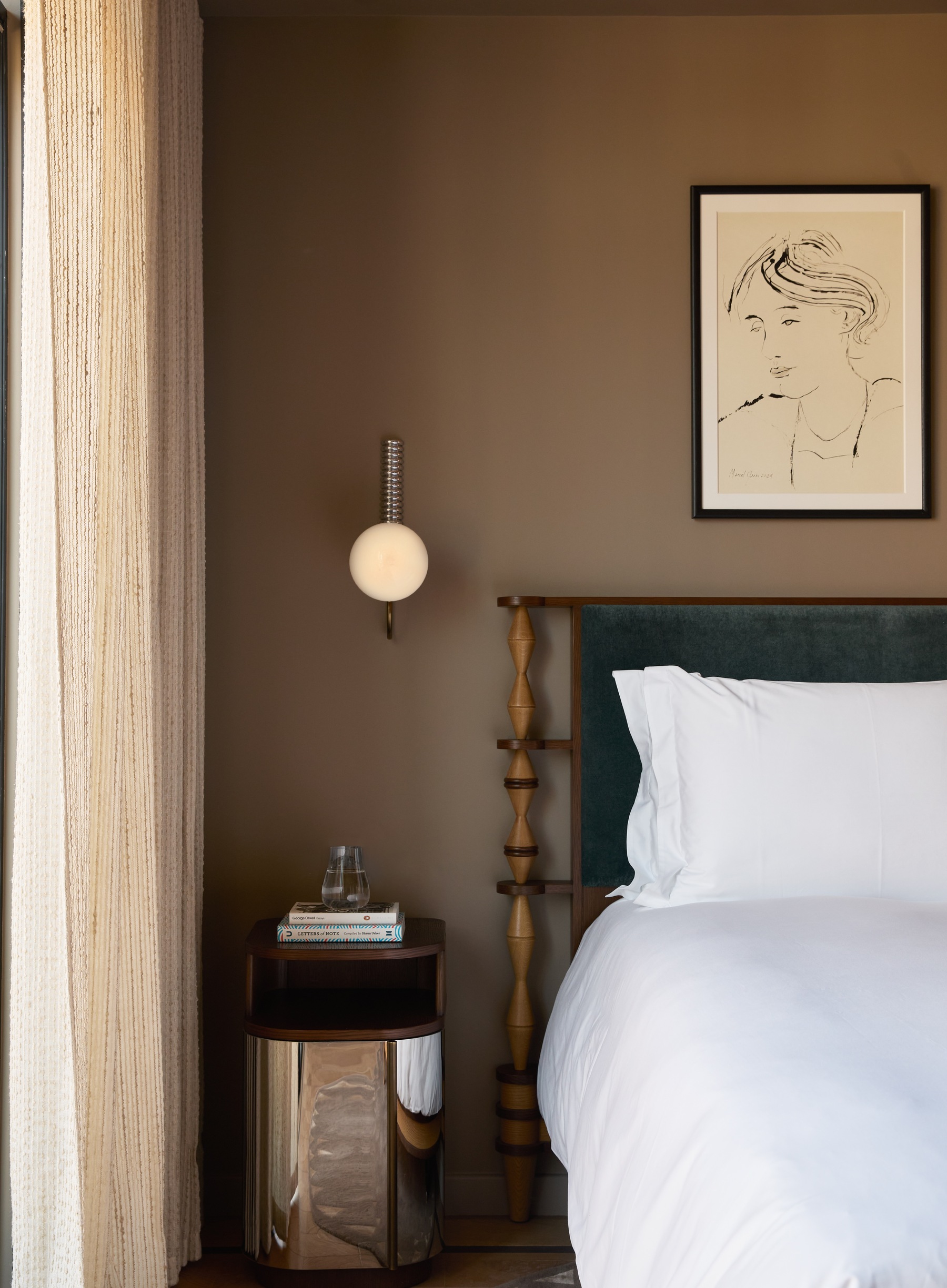
Geometric patterns throughout the rooms nod to the avant garde energy of Nancy Cunard without literal replication. Her bold stacked bangles, which she famously wore dozens at a time up her arms, inspired the sculptural bedposts that appear in every room. Her playful fondness for polka dots found its way into the patterned floors, a touch of whimsy that feels both unexpected and completely right. Even the chandeliers reference the circular stacking forms of her signature jewellery, transforming her aesthetic from wearable art into architectural detail.
Artwork throughout the hotel introduces Fitzrovia's past and present without turning the building into a museum of itself. Photographer Rory Langdon Down contributed portraits of local residents and small business owners that hang throughout the 81 rooms and public spaces. Not stock photography of anonymous faces, but real people who live and work on these streets. General Manager Oliver Milne Watson encountered two of the photographed subjects while spending time in the neighbourhood recently, a moment that perfectly captures the hotel's relationship with its surroundings.
There are no plaques explaining references, no heavy handed storytelling devices. Context is present, but discovery is left to the guest. What sets The Newman apart from most new London openings is not design alone, but intent. From the beginning, it was planned as a place locals would actually use. Public spaces designed for familiarity rather than theatre. A hotel that could exist comfortably in Fitzrovia without asking the neighbourhood to adapt to it.

Gambit Bar: Descent Into Fitzrovia's Occult Past
Below street level, down a spiral staircase through a mirrored tunnel, Gambit forms the social centre of the building. The descent matters. You leave routine at street level. Massimo, the bar manager, designed the journey to feel like walking into another dimension. That is not hyperbole. The transition is deliberate, almost ceremonial.
The floor reveals itself first. Symbols from Thelema, the religion Aleister Crowley invented in the 1920s, are embedded throughout the flooring design. Crowley was a prominent Fitzrovia figure during that era, deeply involved in occultism, black magic, and esotericism. The bar's entire aesthetic references that occult period. The color palette. The retro line work. The geometry. It is esoteric design without being theatrical. Details reveal themselves slowly as you settle in, not immediately upon entry.
Look up and the ceiling tells another story. The coffered design references Wyndham Lewis and Vorticism, the British avant garde movement that shattered Art Deco forms and reimagined them with sharp edges and fractured geometry. Lewis was another Fitzrovia figure from the same era as Crowley and Cunard, part of the neighbourhood's bohemian explosion in the 1920s. The ceiling interprets his aesthetic without replicating it directly.
Gambit is not framed as a hotel bar, but as a local one that happens to sit beneath a hotel. The space is designed for long stays rather than quick impressions. Green velvet booths offer intimacy without isolation. Seating encourages conversation, not turnover. Lighting is warm and human. A small stage sits ready for live performances. Music is treated as part of the space's identity rather than background noise.
The drinks programme, curated by Eder Nato, reflects a philosophy that extends throughout the building. Every signature cocktail is available in a non alcoholic version that genuinely replicates the flavor profile. Excitement and Fate combines rum, pineapple, cherry, shiso, and sesame. True Gift reimagines a Picante with tequila, lime, bird's eye chillies, blood orange, and smoked salt. The complexity and depth match across both alcoholic and non alcoholic versions. This is not a token gesture. It is a parallel menu treated with equal seriousness, reflecting a broader understanding of wellness that extends beyond the spa floor upstairs.
Local craft beers on tap include Two Tribes from King's Cross and Kernel from Bermondsey. The bar menu, designed by Chef Turner, offers flatbreads, oysters, and rullepølse, Danish cold cuts that complement drinks without competing for attention.
Massimo grew up in a bar in northern Milan. His family ran it for decades. He remembers running between tables as a child, remembers his family opening on Christmas Day just to share bubbles and dessert with neighbours walking past on the street. That community spirit is why he is here. The Newman reminded him of home. When he talks about wanting locals to know him by name and him knowing theirs, you believe him entirely.
Music matters here in a specific way. The partnership with Gibson guitars happens twice a month. Emerging local musicians from Fitzrovia's streets get a stage, professional equipment provided, visibility guaranteed. The bar is not manufacturing a scene. It is supporting one that already exists. Chess nights. In house DJs. Programming that rewards regular attendance rather than one off visits.
Dogs are welcome at Gambit. Not as a marketing statement, but as neighbourhood reality. Locals and guests sit together without distinction. Conversations overlap across booths. The bar opens Tuesday to Saturday, 5pm to midnight. It does not attempt to dominate. It simply exists consistently.
A Wellness Floor That Means It
An entire floor dedicated to wellness feels unusually generous in central London, where space costs what it costs. Wellness at The Newman, as they have branded it, embraces principles from the Swedish Grace Movement of the 1920s. The same era as Nancy Cunard. The same cultural moment that shaped Fitzrovia's bohemian identity. Minimalism meeting functionality. Innovation rooted in comfort rather than spectacle.
The space is calm, softly lit, designed around flow rather than efficiency. Curved walls replace sharp lines throughout. Textures invite touch. Natural materials dominate. Oak. Bronze. Leather. Christabel Balfour tapestries hang on walls, adding warmth without clutter. It does not feel clinical, which so many hotel spas do. It feels considered.
The offering centres heavily on contrast therapy, the Scandinavian practice of alternating hot and cold exposure. A Finnish sauna and steam room for heat. An Ice Lounge for cold. Multi sensory experience showers that combine temperature, sound, light and scent into ritualized transitions between states. A medical grade halotherapy room where you breathe air saturated with salt particles, dispersed through patented technology that covers surfaces and heats benches. The practice is said to benefit respiratory health and skin conditions. A hydrotherapy pool anchors the space, drawing guests back repeatedly during their stays.
The gym integrates high end Technogym equipment without feeling sterile. Massage guns and foam rollers sit alongside machines. There is a salt walled fitness studio. A dedicated yoga studio. Everything is accessible 24 hours a day, seven days a week for guests.
Treatment rooms incorporate sound rituals using singing bowls to begin and end sessions, grounding guests before and after treatments. Products come from partnerships with Scandinavian clean beauty brand Nuori, marking their first London hotel presence, Moss of the Isles which uses active ingredients from Ireland and the British Isles, and science led CBD brand KLORIS. Every treatment has been designed exclusively for The Newman rather than imported from existing spa menus elsewhere.
It is not a spa built for spectacle or Instagram moments. It is built for return visits, for guests who actually use wellness facilities rather than simply note their presence. Wellness here is not confined to one floor. It appears throughout the building. In room design prioritising sleep. In bar menus offering thoughtfully curated low and no alcohol options. In food that leans lighter without being restrictive or worthy.


Rooms That Prioritise Sleep Over Display
The rooms themselves continue this logic. They are quietly detailed rather than decorative. Nothing demands attention. Materials are tactile and warm. Beds are fitted with organic Natramat toppers chosen for sleep rather than trend, the same brand used at home by guests who prioritise genuine rest over hotel theatre. A pillow menu offers nine options. Linen feels substantial without being heavy.
The windows are impressively soundproofed, an essential detail given the hotel's central location, and one that becomes obvious the moment you close them. Fitzrovia's hum disappears completely. The room becomes a capsule where sleep arrives quickly and holds through the night uninterrupted.
Books are curated by floor, pairing titles tied to Fitzrovia's literary history with contemporary London guides. Coffee has been tested extensively to work properly with in room machines, a detail so many hotels overlook. Yoga mats sit tucked away in wardrobes, part of a wider effort to integrate wellness throughout the building rather than confine it to a single floor. The TV includes Earth and Sky subscription for in room yoga and Pilates classes.
Smart TVs, minibars, tea and coffee making facilities, free bottled water, bathrobes, slippers, and Anatomē bath products complete the offering. Everything feels considered but not overthought. These are rooms designed to be lived in, not photographed and forgotten.
Rooms start from £495 per night for Deluxe categories. The signature suites on the sixth floor are named after female medical pioneers who worked at the nearby Middlesex Hospital. Elizabeth Garrett Anderson, one of the UK's first female practitioners. Florence Nightingale, whose penthouse occupies the entire rooftop with a 130 square metre private terrace. The terrace includes its own six person Finnish sauna, brass monkey ice plunge pool, and fire pit, with uninterrupted views across Fitzrovia to the BT Tower. Contrast therapy at sunrise, 70 meters above central London. When booked as a whole, the sixth floor offers four beautifully designed bedrooms accommodating up to ten guests with exclusive use of the entire level.
A Brasserie That Opens to the Street First
The decision to open Brasserie Angelica to the neighbourhood before opening the hotel upstairs was not marketing. It was survival. In a neighbourhood that never wanted a hotel, you prove you belong before you ask anyone to sleep there.
On the ground floor, Brasserie Angelica, named after Virginia Woolf's niece Angelica Garnett, behaves more like a neighbourhood institution than a hotel amenity. The space has its own street facing entrance at 49 Newman Street. Its own identity. Its own rhythm. You can walk past and not immediately realise there are rooms above. That sequence was intentional from the design brief. People should discover the restaurant first, then realise there's a hotel attached. Not the other way around.
This was the test. If Fitzrovia locals adopted the brasserie, if office workers from surrounding agencies came in for lunch, if the neighbourhood treated it as theirs rather than a hotel restaurant they avoided, then The Newman had earned the right to exist.
The brasserie's design by Lind + Almond blends Victorian and contemporary Art Deco influences drawn from surrounding buildings. Large windows flood the space with natural light. There's a street side terrace for warmer months. The dining room seats 76, with an additional 24 in a separate bar area that functions independently but connects seamlessly when needed.
Head Chef Christian Turner, formerly of the Wolseley Hospitality Group, has built a menu that reflects years spent in London brasseries rather than hotel restaurant trends. Northern European influences appear throughout. Gravlax. Västerbotten cheese tart. Chicken and tarragon pie executed with care. A Josper grill anchors the kitchen, bringing depth and smokiness to both meat and vegetables that cannot be replicated elsewhere.
Walk ins are sacred here. Not as policy, but as philosophy. Reservation systems exist, but tables stay available for people coming off the street. That is brasserie tradition. That is also how you prove to Fitzrovia you mean what you say. The menu runs from 7am breakfast through to late evening, seven days a week.
At lunch, a smørrebrød trolley makes the rounds. Open sandwiches for office workers from surrounding agencies who want quick, healthy, well made food without fast food compromise. It is a specific answer to a specific neighbourhood need identified during those months of walking streets and watching patterns.
Office workers from the surrounding streets already drift in before the hotel has officially opened. Locals talk about events they attended or missed but plan to return for. The brasserie opened its doors to neighbours two weeks before it opened to hotel guests. That sequence matters in a neighbourhood that never wanted a hotel. You do not arrive and expect acceptance. You earn it, table by table, lunch by lunch, until the neighbourhood decides you can stay.
Two private dining rooms, Talland and Little Talland, are named after Virginia Woolf's Cornwall holiday home. They can be reserved individually or combined with the bar below for exclusive use of the entire floor.
Hospitality Without Performance
What defines The Newman most clearly is not its design or location, but its operating philosophy. Luxury here is not expressed through ceremony or formality. It appears in memory, intuition, and ease.
Teams move across departments fluidly, reinforcing a culture where responsibility is shared and service feels human rather than rehearsed. When you arrive, there is no grand fanfare, but the team knows your name by the time you reach reception. It is a party trick, executed artfully, without the forced enthusiasm that defines so many luxury properties.
Guests are not segmented by status or purpose. Locals and visitors occupy the same spaces on equal terms. The hotel does not ask to be treated differently from its surroundings. It simply shows up consistently.
This approach extends beyond guests to the neighbourhood itself. Opening a new hotel in London inevitably changes the street it sits on. At The Newman, the aim has been to ensure that change feels additive rather than extractive.
The hotel partnered with Saira Hospitality, a nonprofit organisation, to run a pop up hospitality training school over summer 2025. The programme supported individuals facing barriers to employment in the local community, providing knowledge and skills to build careers in hospitality. The Newman recruited several team members from this pool of candidates, hiring 40 percent more graduates than originally planned.
Staff greet each other with warmth. Conversations feel unforced. There is a sense of pride that does not tip into performance. One team member mentions this is the best job they have had. They arrive happy and leave happy. It sounds simple, but it explains a great deal.
The hotel runs entirely on renewable energy through partnerships with suppliers like Tem Energy. The restaurant prioritises British made seasonal produce. Furnishings, artwork, tiling, lighting, all sourced from sustainable suppliers. Rigorous recycling schemes operate throughout. Staff work closely with London charities and volunteer programmes to give back to the communities around them.
The Newman is wheelchair accessible, with step free access to the building and a wheelchair lift serving the lobby and restaurant. Rooms are spacious to allow for wheelchair access. Four rooms, three Deluxe and one Studio, have been specifically adapted with roll in showers and grab rails for guests with limited mobility. The hotel is pet friendly for small to medium sized dogs at £50 per stay. Dogs are welcome in public areas and on the rooftop terrace, though not in the main restaurant.
Opening With Proof, Not Promises
As The Newman opens February 1st, 2026, it does so having already answered the question Fitzrovia never asked but needed answered anyway. What would a hotel look like if it had to earn acceptance from a neighbourhood that spent decades successfully resisting them?
The answer is not found in grand statements or opening night spectacle. It is found in the office worker who has been coming to Brasserie Angelica for lunch three times a week for the past two weeks. In the local who brings their dog to Gambit Bar on Thursday evenings. In the neighbour who stops Chef Turner on Newman Street to talk about that week's menu. In the fact that when the hotel officially opens, Fitzrovia already knows it belongs here because The Newman proved it before asking for permission.
The morning after the pre opening stay, a delivery arrives at Brasserie Angelica. Chef Turner steps outside to inspect produce. A neighbour walking past stops to chat. They discuss the restaurant, plans to book a table, how it is good to see the building finally open after months of watching the transformation from the street. It is an unremarkable exchange. Which is precisely the point. The Newman has become unremarkable in the best possible sense. It exists as part of Fitzrovia's rhythm rather than disruption of it.
Built with community in mind and shaped by the realities of Fitzrovia rather than the expectations of the luxury hotel market, The Newman presents a different model for hotel openings in neighbourhoods that resist them. One that values belonging over branding, longevity over launch hype, and familiarity over performance. One that understands you cannot buy acceptance from a neighbourhood that never wanted you. You can only earn it.
From the ground floor at 50 Newman Street, it is a four minute walk to Goodge Street station, six minutes to Tottenham Court Road, and 35 minutes to Heathrow Airport via the Elizabeth Line. Oxford Street, the British Museum, West End theatres, and Covent Garden all sit within a 15 minute walk. The location gives you central London without the chaos or formality of neighbouring areas.
In February 2026, Fitzrovia gets its first proper hotel. Not because the neighbourhood wanted one, but because The Newman understood what it would take for a neighbourhood that never wanted a hotel to accept one anyway. The difference between those two things is everything.
Entirely Fitzrovian, indeed. Even if Fitzrovia never asked for it.