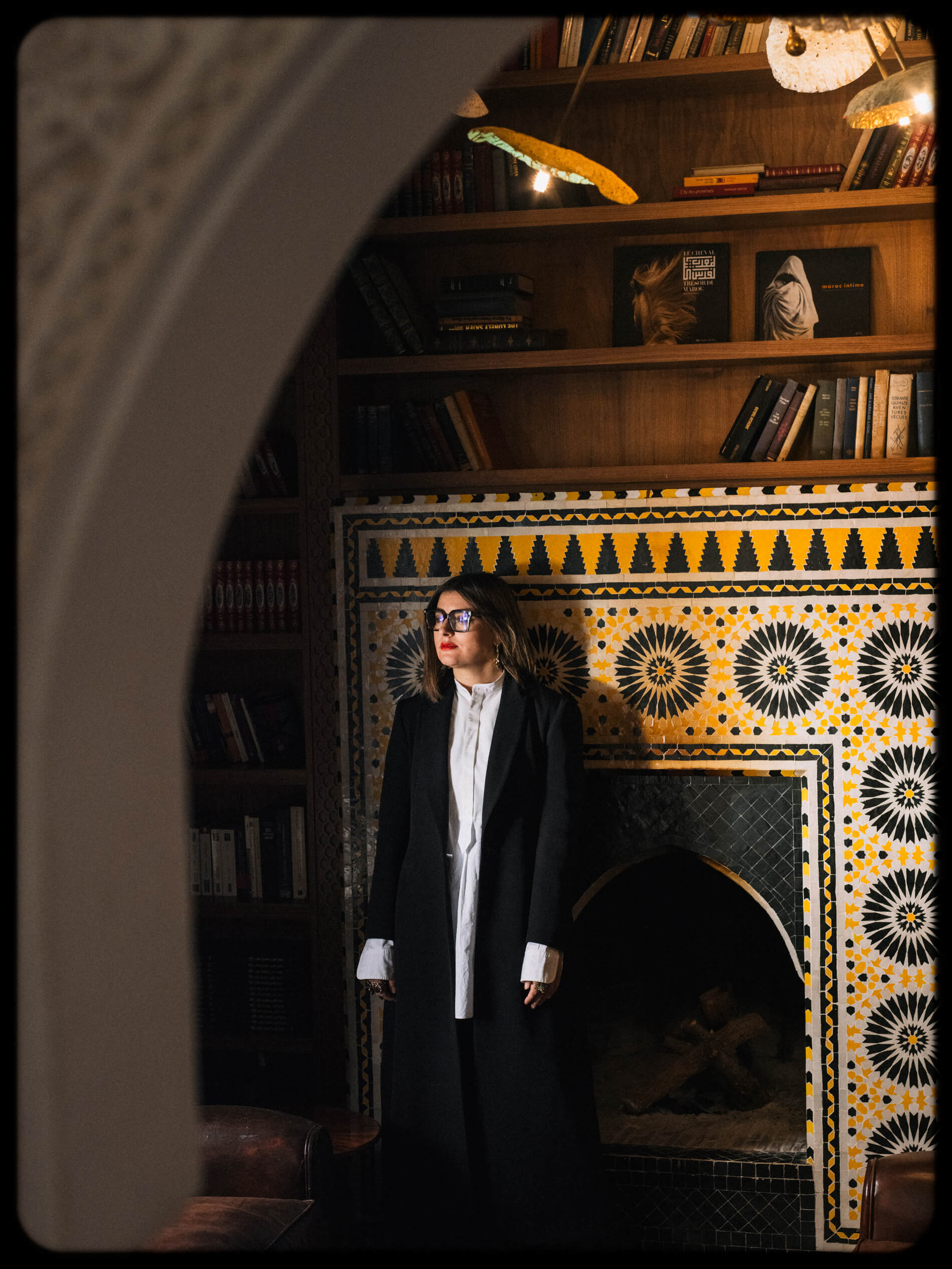
The project she walked into was enormous. Seven riads being stitched together into a single property, designed by the Marrakech architecture firm Archimath under Amine Kabbaj, with Malaysian born, London based San Yetlee leading the overall branding and interior concept. The brief demanded something few hotels attempt with any sincerity: the marriage of Moroccan handcraft with mid century Western furniture, of ancestral artisan technique with a contemporary art collection worth more than five million pounds. The timeline kept extending because the art kept demanding adjustments to the architecture. A space would be built and then the artwork placed inside it and the two would not quite speak to each other, and the space would need to change. What qualified Aisha for this was not a degree or a portfolio. It was Marrakech itself.
"I think what helped me is that I'm from Marrakech. I always been immersed in handcraft and what's going on around. Even from young, I was walking in the street or the markets and trying to understand what's happening there. What's the material, how the artists use or work their finish. I was always asking questions about every single detail I see in the souks."
Bill Willis arrived in Marrakech in 1966 with John Paul Getty Jr and his wife Talitha. He never left. Over the following four decades he designed Villa Oasis for Yves Saint Laurent and Pierre Bergé in the Majorelle Garden, built and rebuilt homes for the Rothschilds and the Agnellis, revived craft traditions that were on the verge of extinction, and in the process made Moroccans fall back in love with their own architectural heritage. He was Tennessee born, educated at the École des Beaux Arts in Paris, handsome and hedonistic, famous for his parties and infamous for his debts. He died in 2009 in his house in the Medina, a place called Dar Noujoum. His legacy is in the buildings. He left no archive, no manifesto, no school.
Aisha holds what Willis left behind not as history but as creative method. She understands his choices not because she has read about them but because she works with the same materials every day, in the same city, with the same artisan communities.
"Bill Willis was the one who took tadelakt out of the bathroom and into outside areas, living rooms and so on. And those are things that you would not know."
She runs her hand along a wall in the reception. The surface is warm and impossibly smooth, the particular quality of polished lime plaster that Moroccan builders had traditionally used only in hammams because of its waterproof properties. Before Willis, it stayed there. He saw something the builders had not: that the material itself was beautiful enough to exist everywhere. The same is true of zellige, the mosaic tilework that now appears in every fashionable riad in the city. Before Willis, zellige followed strict conventions of colour and pattern. He broke both. He used turquoise where turquoise had never been used. He laid tiles in configurations that craftsmen considered wrong and that tourists now photograph without knowing whose eye made them possible.
"He was very avant garde at that time. Nobody would do this before."
At IZZA, these innovations are not displayed behind glass. They are the building. The zellige around the central fountain, the tadelakt on every wall, the plaster arches carved by artisans from Marrakech, the tiles sourced from craftspeople in Fes. Aisha oversaw the selection and placement of every surface, every vintage mid century chair, every brass light fixture that catches the afternoon sun and sends it somewhere new.
"We chose to do more green colour. This is a main colour that we are known with, because green is the colour used in Moroccan architecture. And we are surrounded by gardens and plants. We wanted to be in a place that reflects its beauty. Green is a colour of peace and serenity."
The aesthetic she built is not a reproduction of Willis's style. It is a continuation of his principle: that Moroccan craft and Western design can occupy the same room without either one surrendering.
The interior of IZZA operates on what Aisha calls layers of stories. This phrase is central to everything she does and everything the hotel is. There is the story of the architecture itself, the seven ancient houses and what they were before they became one. There is the story of the mid century furniture, each piece sourced individually, each one carrying its own provenance and its own decades of use. There is the story of the art collection: more than three hundred works, including pieces from Leila Alaoui's arresting Les Marocains series that hang in the reception lobby, generative digital art by Tyler Hobbs and Refik Anadol, and photography by Sebastião Salgado. And there is the story of Bill Willis himself, which lives most vividly in a room on the first floor called Bill Willis's Bar.
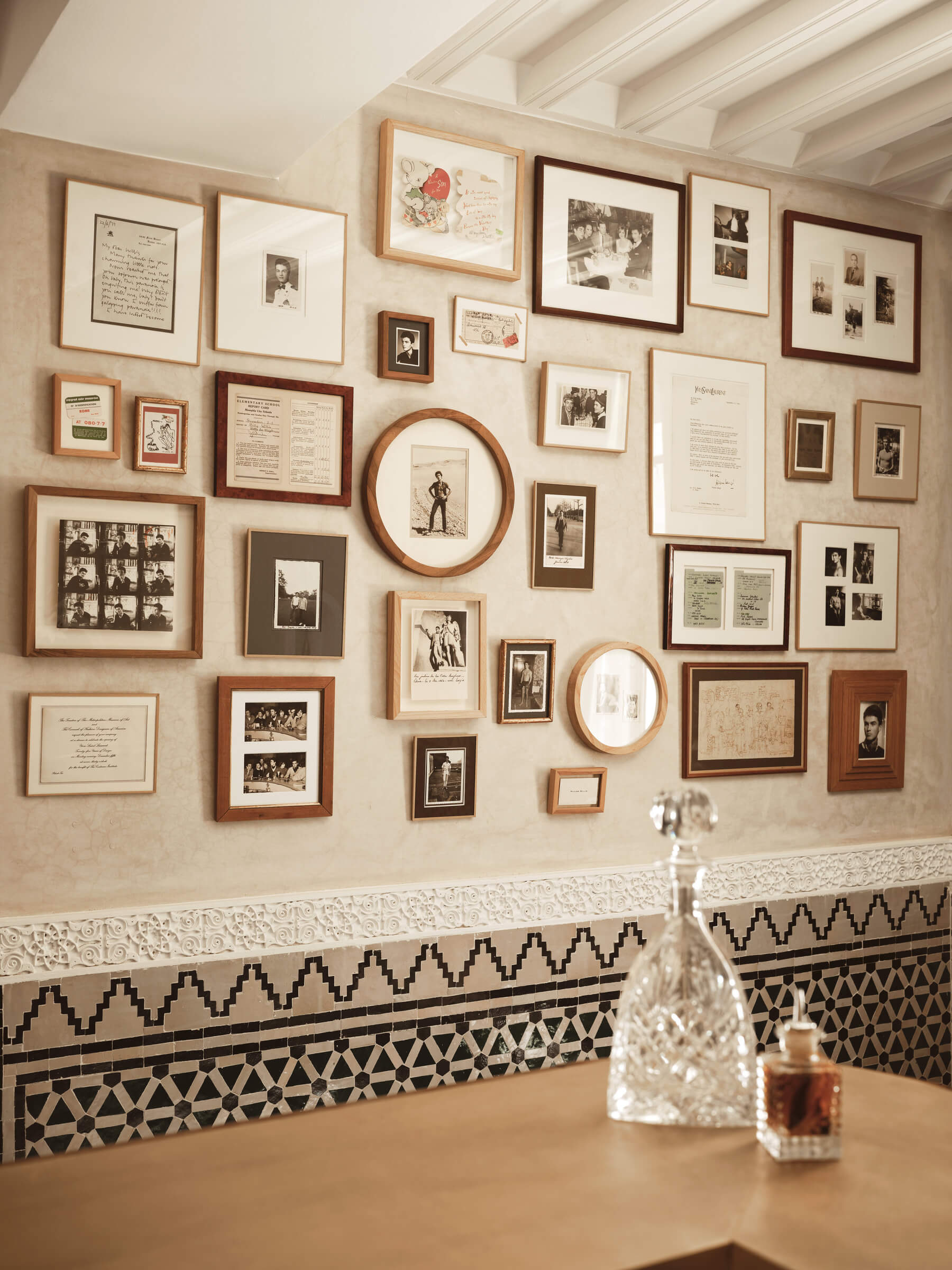
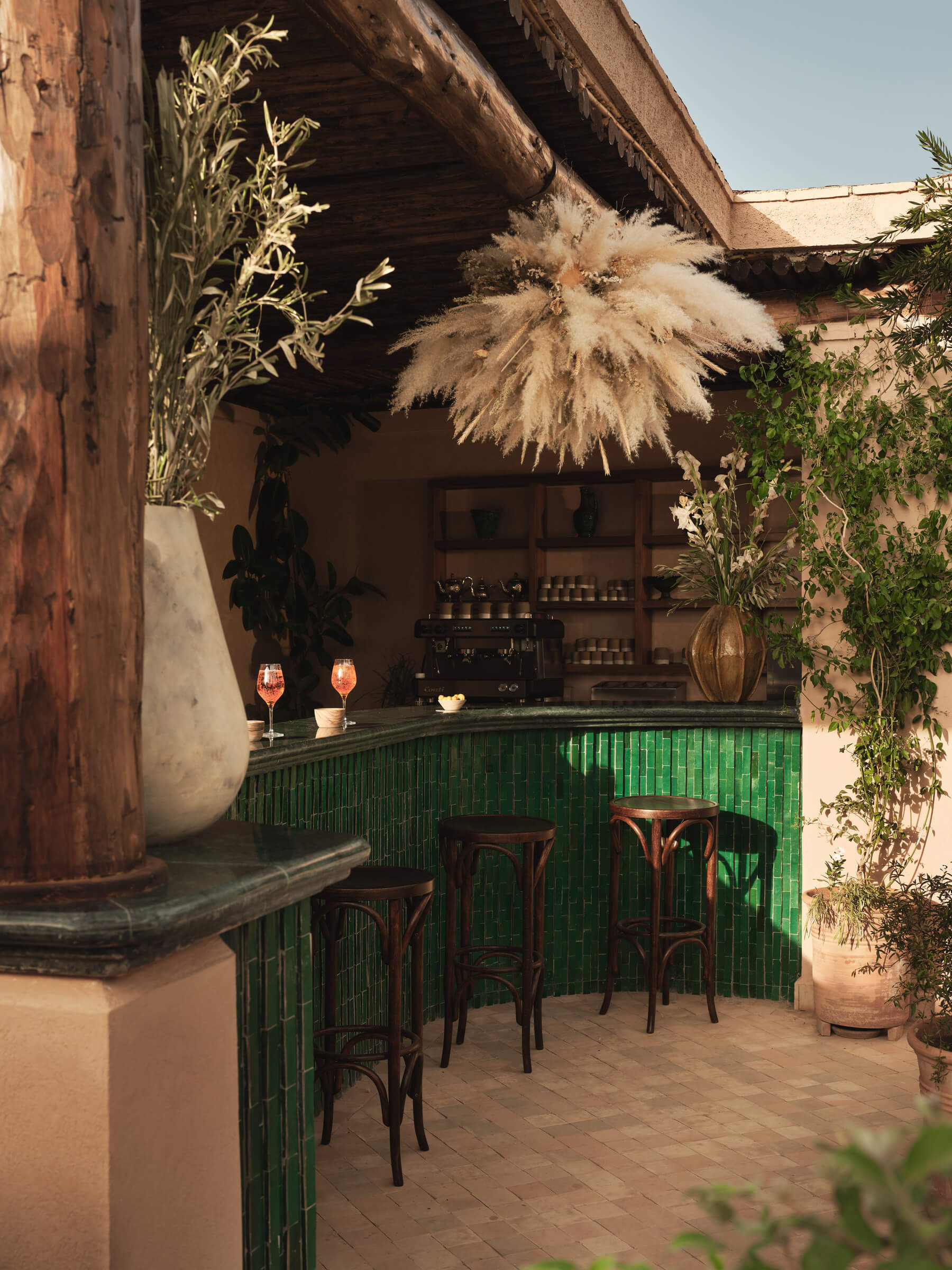
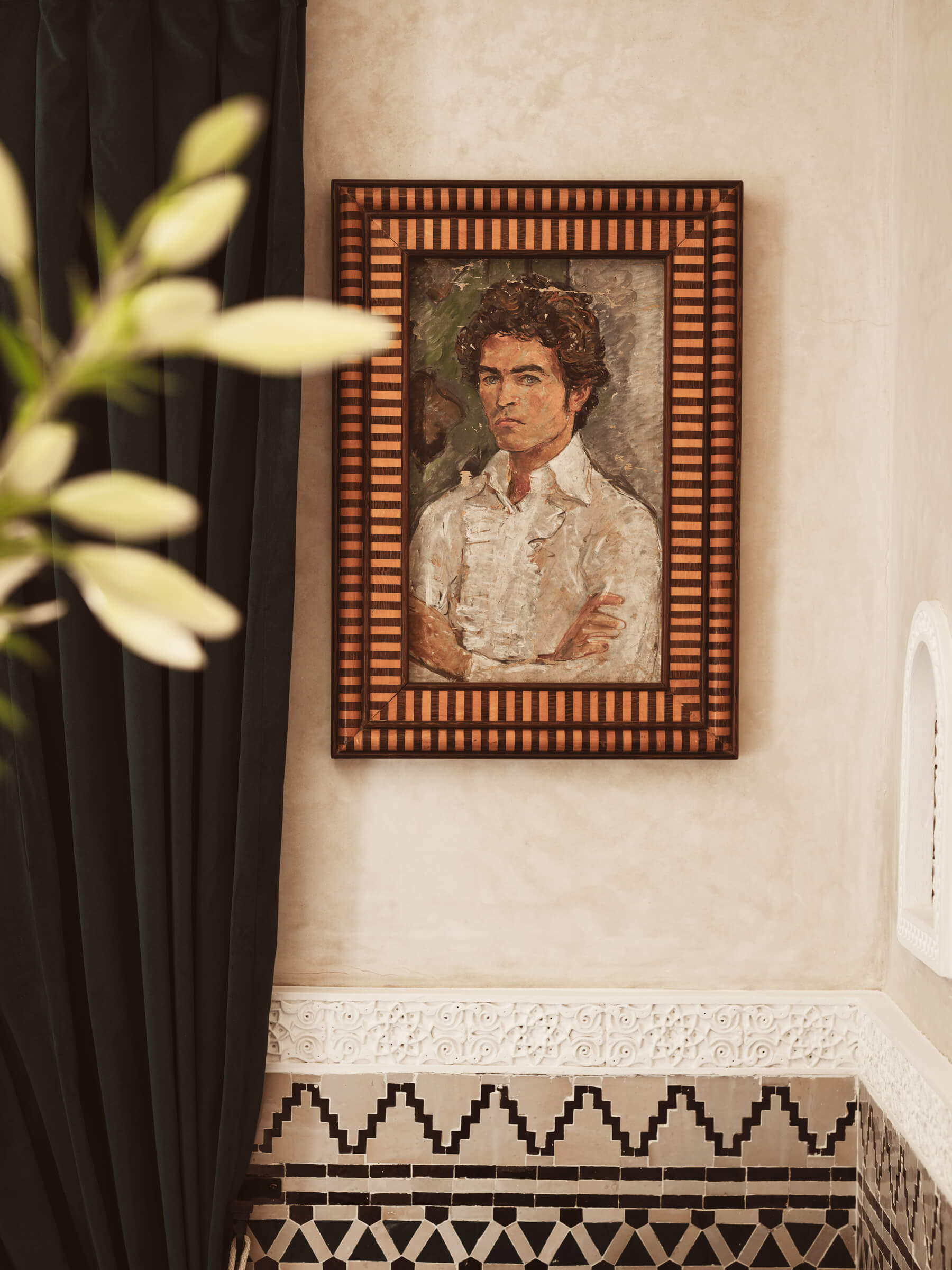
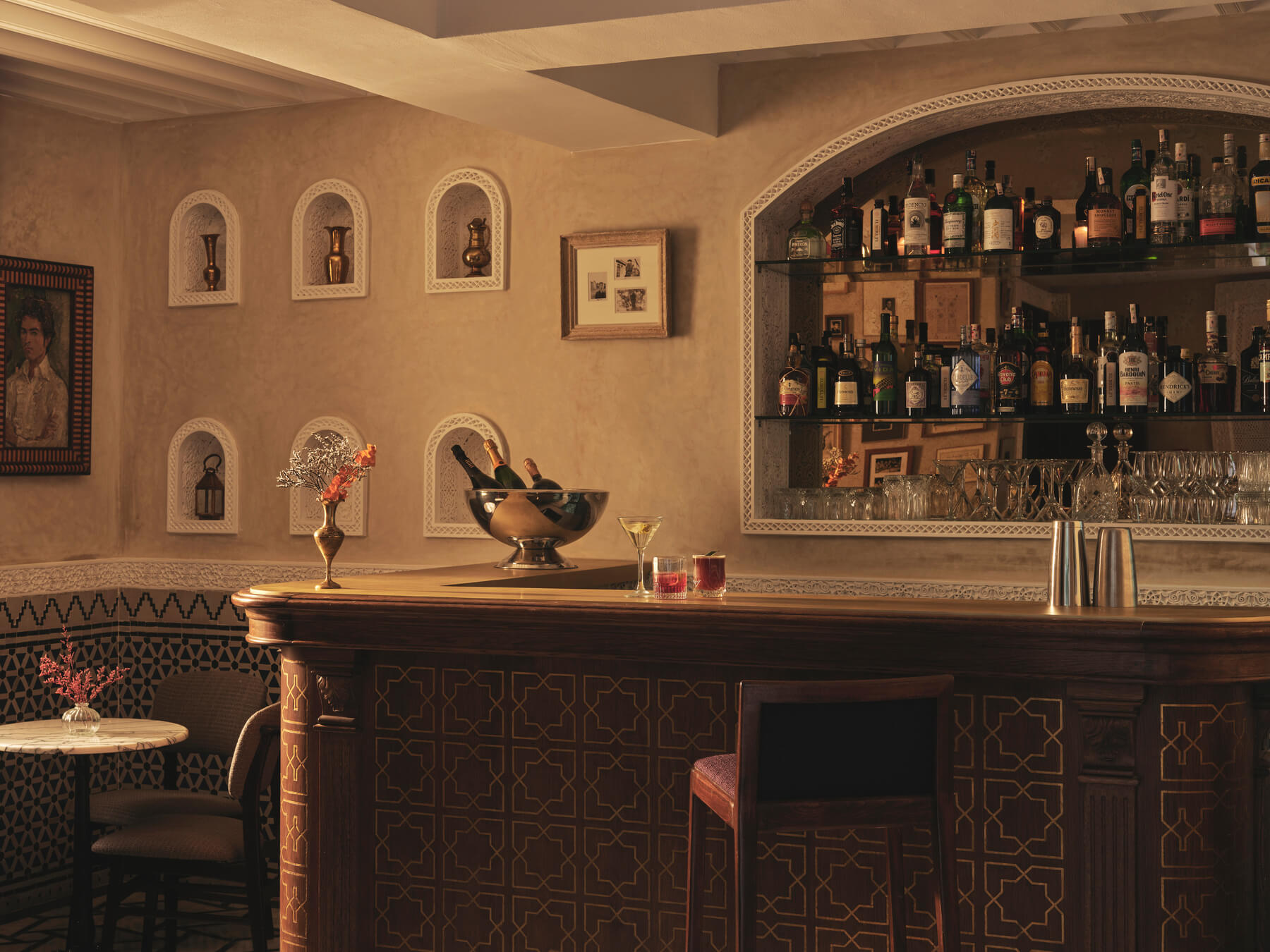
The bar is small and warm and lined with his personal archive: photographs, sketches, documents, and a letter from Yves Saint Laurent to Willis that scolds him for spending money on his "useless Range Rover" instead of paying his debts. There is an original portrait of Willis from the 1970s. The drinks are classic cocktails because he loved them. The black and white floor references one of his most famous projects, Rick's Bar from the film Casablanca. The whole room feels like sitting inside one man's life, which is exactly Aisha's intention.
"He wasn't caring about his legacy as an interior architect. Because he was hedonistic. More living his life as an escapist. Doing a lot of parties, doing many projects, but not really documenting his work."
The archive that makes the bar possible was found by accident. When IZZA's owner, the tech entrepreneur Neil Hutchinson, purchased Dar Noujoum, Willis's former home in the Medina, the building was derelict and had been picked through by looters. Everything of obvious value was gone. But tucked into an alcove, missed by everyone who had come through, was a suitcase packed with letters, drawings, photographs and personal mementoes that now line the walls of the bar. Willis's beautiful room sketches adorn the bedrooms too, alongside grainy black and white photographs of a world that no longer exists but whose energy still moves through the corridors. In Moroccan architecture, everything that matters is on the inside.
The rooms at IZZA carry the names of the people who made Marrakech a creative destination in the middle of the twentieth century. Yves Saint Laurent, who said that before Marrakech everything was black, and that this city taught him colour. Talitha Getty, who arrived on her honeymoon and whose husband commissioned Willis to redesign their crumbling palace. Grace Jones. Marianne Faithfull. Jack Kerouac. Allen Ginsberg. Cecil Beaton. And Christine Alaoui, the French socialite whose daughter Leila became one of Morocco's most important photographers.
"All of them took something from the city. The colours, the smell, the architecture, the design, the art. And all of them inspired the city."
Each name is chosen not for celebrity but for a specific creative relationship with this place.
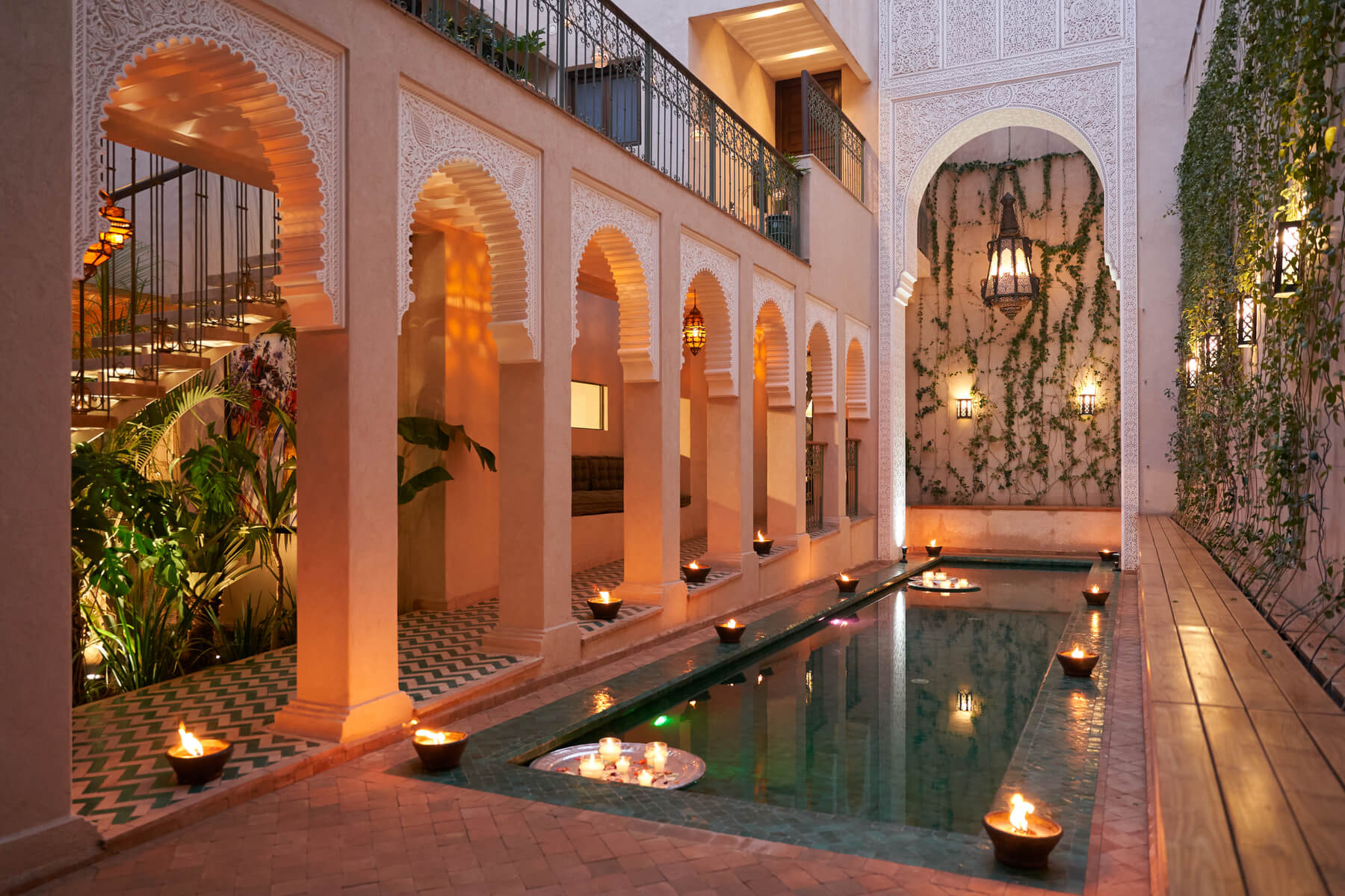
In the oldest of the three riads, the one at the very back of IZZA where the walls are thickest and the palms grow tallest, there is a particular quality of silence. Not the absence of sound but the presence of something else, the accumulated weight of centuries of people living behind closed doors in the Medina, building beautiful things where no one could see them. Aisha Benazuz spent fourteen years doing work that had nothing to do with this. Then she opened a door and found the whole of her life waiting on the other side. Bill Willis left Marrakech nothing but the buildings themselves. No archive, no manifesto, no school. Just the walls and the tiles and the principle that craft, properly understood, could be the most contemporary thing in the room. Someone had to carry that forward. Someone from here. In a city where every door hides something, and every surface holds the memory of the hand that made it, she is the person who makes sure none of it is forgotten.