The story of how an aristocrat's tuberculosis sanatorium became a five star mountain hotel that honours its healing past
The original building was never meant for pleasure. It was commissioned between 1927 and 1929 by Anna Mela Papadopoulou, an aristocrat and Hellenic Red Cross volunteer who gave up her bourgeois lifestyle to dedicate herself entirely to treating wounded soldiers and tuberculosis patients. Mela travelled across three continents, raising funds from diaspora Greeks in the United States and Egypt to build the sanatorium. She chose this exact spot in the Arcadian forest for its altitude and the healing properties of mountain air, where legend has it that the god Pan once roamed. Built by skilled stone masons from Lagadia using plans by a Swiss architect, the building followed the European model of alpine recovery architecture. Thick stone walls quarried directly from the mountain. Tall, narrow windows built to control airflow and let patients breathe properly. Long corridors that kept people isolated. A structure designed to hold cold, survive weather, and offer nothing except forest air and silence. Among patients, Mela became known as Mana, the Mother of the Soldier, for her total devotion. The sanatorium operated until 1938, when penicillin became accessible and rendered such facilities obsolete. Anna Mela died that same year, tragically of tuberculosis herself.
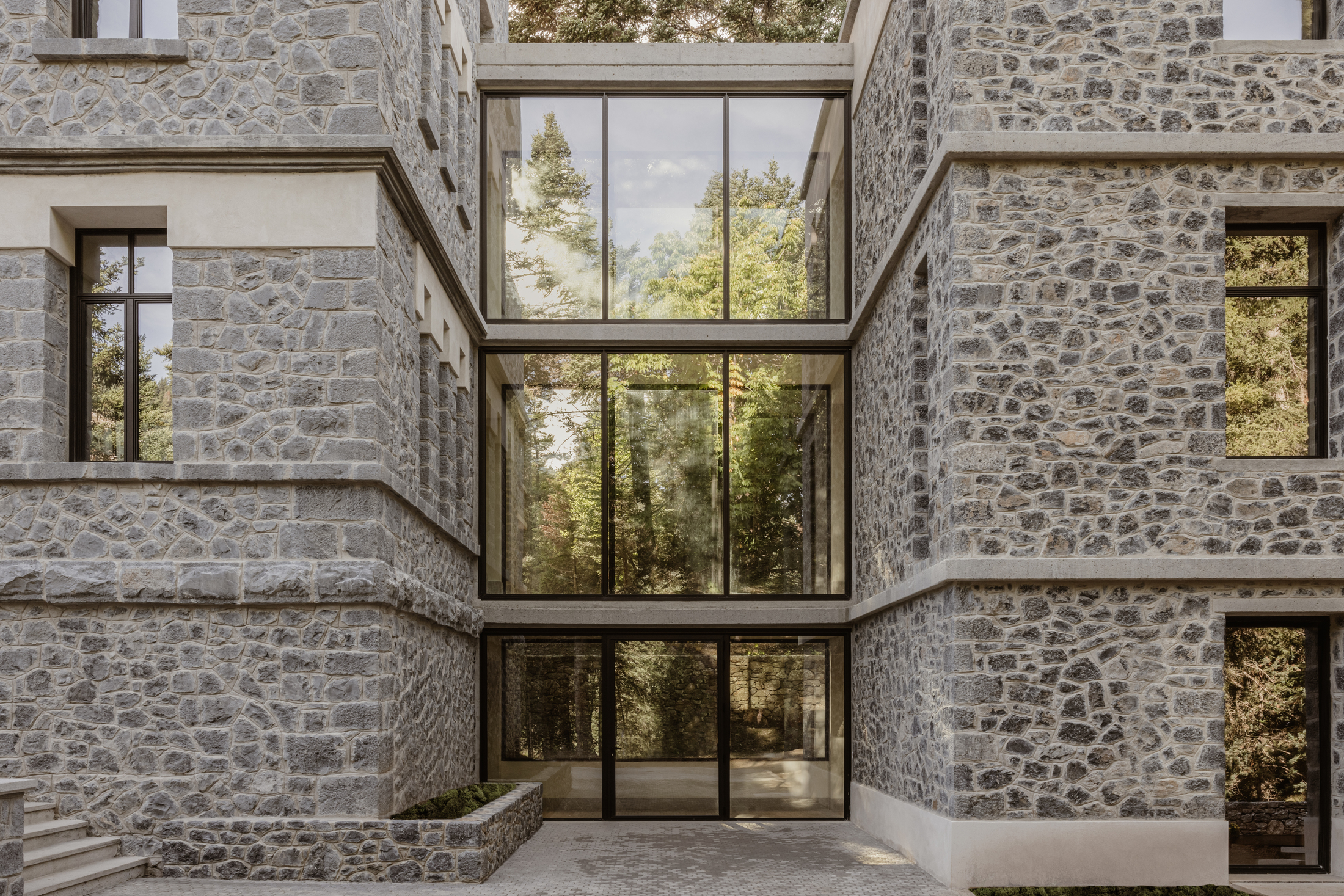
K Studio did not try to erase that history. They sharpened it. Working with archaeologists and reviewing extensive archival material, the team completed what they describe as a historically accurate renovation that preserves the building's soul while creating a contemporary luxury hotel. The architecture remains strict, almost monastic in places. Stone was restored by Arcadian craftsmen who have worked with this material their entire lives. Chestnut timber was sourced from nearby forests, not because it tells a good story, but because it behaves correctly at this altitude. Original iron doors with ornate muntins were preserved. Windows were upgraded but not redesigned, keeping the verticality and discipline that make the building feel serious. Lighting throughout the hotel was designed by Eleftheria Deko, the acclaimed specialist who also created the multiple award winning lighting for the Acropolis in Athens. Her work here establishes a natural ambiance that shifts with the time of day and the weather outside, never theatrical or staged. Most luxury hotels in Greece copy their design language from the islands. Manna started with what was already standing. The result feels more contemporary than anything built yesterday because the building's bones were always decades ahead. Strong lines. Honest materials. No decoration unless it serves a purpose. A seriousness that somehow becomes restful. For guests used to the Greek coastline, the shift is immediate. Manna does not feel like a hotel playing dress up in history. It feels like a historic building finally given permission to be something real again.
Why thirty two rooms designed as mountain residences make more sense than traditional hotel suites at this altitude
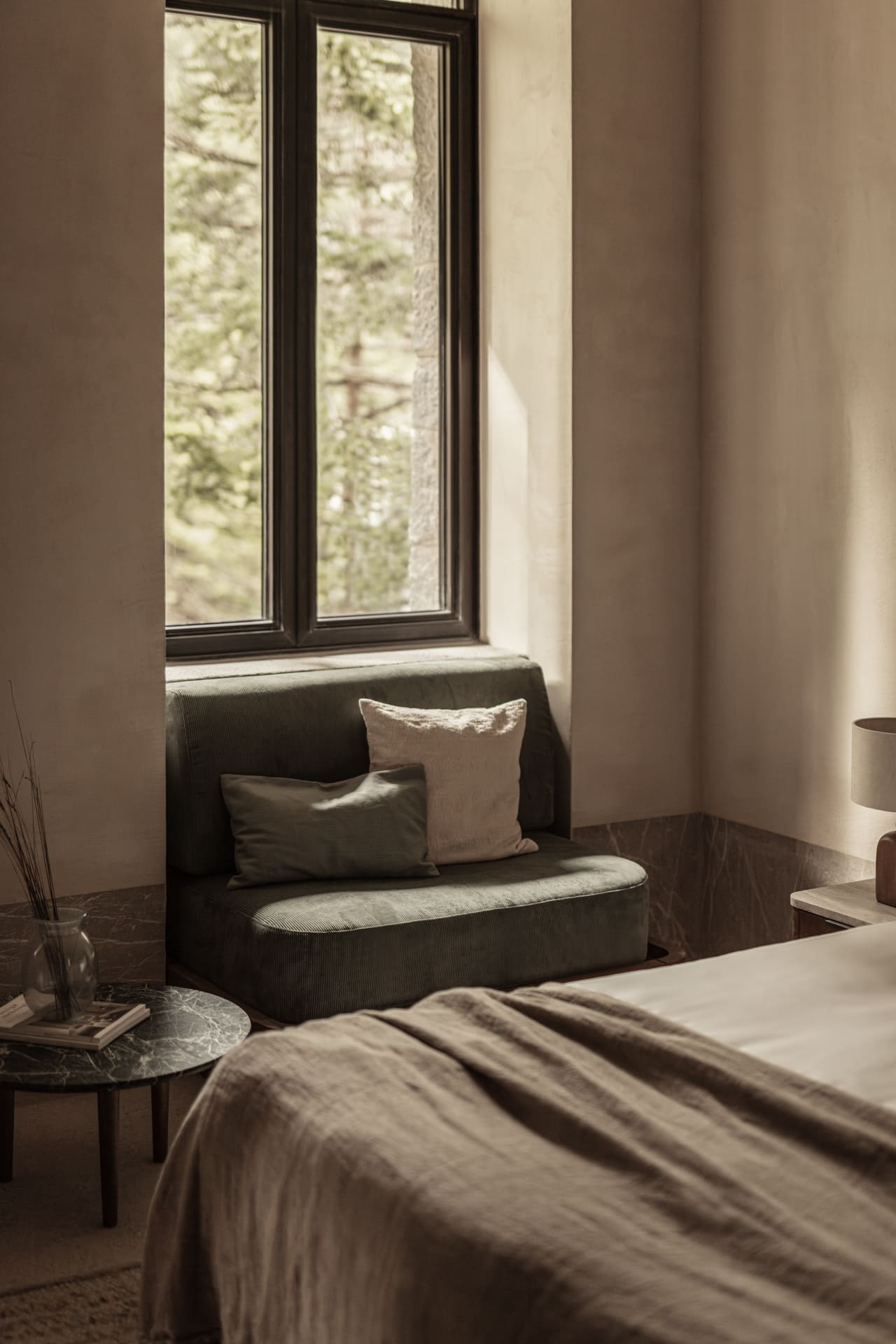
Manna offers 32 individually designed rooms, including six suites, spread across the main building and a rebuilt northern wing. The rooms do not try to impress you in the first thirty seconds. They do not need to. The power comes from proportion, material quality, and how light moves through the space, not from feature walls or statement pieces. Stone walls anchor everything. Chestnut timber warms the atmosphere without softening it. Terrazzo floors inlaid with marble patterns stay cool in summer and work quietly with underfloor heating in winter. The furniture is entirely bespoke, designed specifically for Manna by local craftspeople and handmade to support the architecture instead of competing with it. Colours are pulled directly from the Arcadian landscape: charcoal, moss, ash, mineral white. The layouts follow the sanatorium's original logic. Long, linear, balanced. High ceilings preserved from the original structure. Nothing oversized. Nothing trying too hard. Bathrooms are integrated into the room rather than hidden behind doors, with rain showers and basins carved from local stone. Suites feature freestanding copper soaking tubs positioned to frame forest and mountain views. Lighting is warm but controlled, avoiding the staged glow that makes most resort rooms feel like theatre sets.
Artworks by Greek painter Nikos Kanoglou, British artist Joanna Burtenshaw, and French sculptor Diane Alexandre are carefully positioned throughout the rooms, adding layers of visual interest without cluttering the space. Subtle design details honour the building's history: room numbers are carved discreetly into the floor, and small bells hang in each doorframe, traditionally worn by sheep and goats in the Mainalon Mountains, now serving as a do not disturb signal when hung on the door handle. Every room opens onto a balcony, terrace, or deck. Forest Superior rooms offer private outdoor spaces surrounded by towering firs. Mountain View Superior rooms provide panoramic views across the valley and lily pond. Junior Suites add sitting areas and work desks for guests combining leisure with remote work. The Manna Suite delivers the full experience: sweeping views, generous space, built in sofas, and that copper bathtub positioned where you can soak while watching the forest disappear into evening mist. For travellers choosing between the islands and inland Greece, this is where Manna starts to make sense. These are rooms you can occupy for three or four days without feeling restless. Rooms that hold weather and mood. Rooms that work as well in fog and snow as they do on a clear summer morning. Rooms built for guests who have stayed in enough luxury hotels to know the difference between real precision and expensive decoration.
How Mount Mainalo and the Arcadian landscape become the actual draw rather than just the backdrop
Arcadia does not seduce you the way the islands do. That is exactly what makes it compelling. The landscape is raw, seasonal, and quietly overwhelming. Manna drops you into a part of Greece most international travellers never see because they do not know it exists or have no reason to look. From the hotel, you have direct access to Mount Mainalo's extensive trail network, including the 75 kilometre Menalon Trail, one of Greece's most celebrated hiking routes. The Lousios River, considered one of Europe's cleanest and clearest waterways, offers rafting and canoeing in spring and summer. Winter brings reliable snow and access to the Mainalo Ski Resort. Byzantine monasteries like Timios Prodromos and Philosophos cling to cliffs above the gorge. The Temple of Apollo Epicurius, a UNESCO World Heritage Site, sits within driving distance. Traditional Arcadian villages like Dimitsana, Stemnitsa, Vytina, Karytaina, and Andritsaina still operate on their own logic rather than tourist schedules. Activities extend well beyond hiking. Truffle hunting with trained Lagotto dogs in autumn and winter. Horseback riding through ancient fir forests. Bee harvesting with local producers. Mushroom foraging. Cycling mountain roads. Archery and survival skills training for guests looking for something more adventurous. Visits to nearby wineries in the Nemea region, olive mills, and family run dairies producing exceptional cheeses.
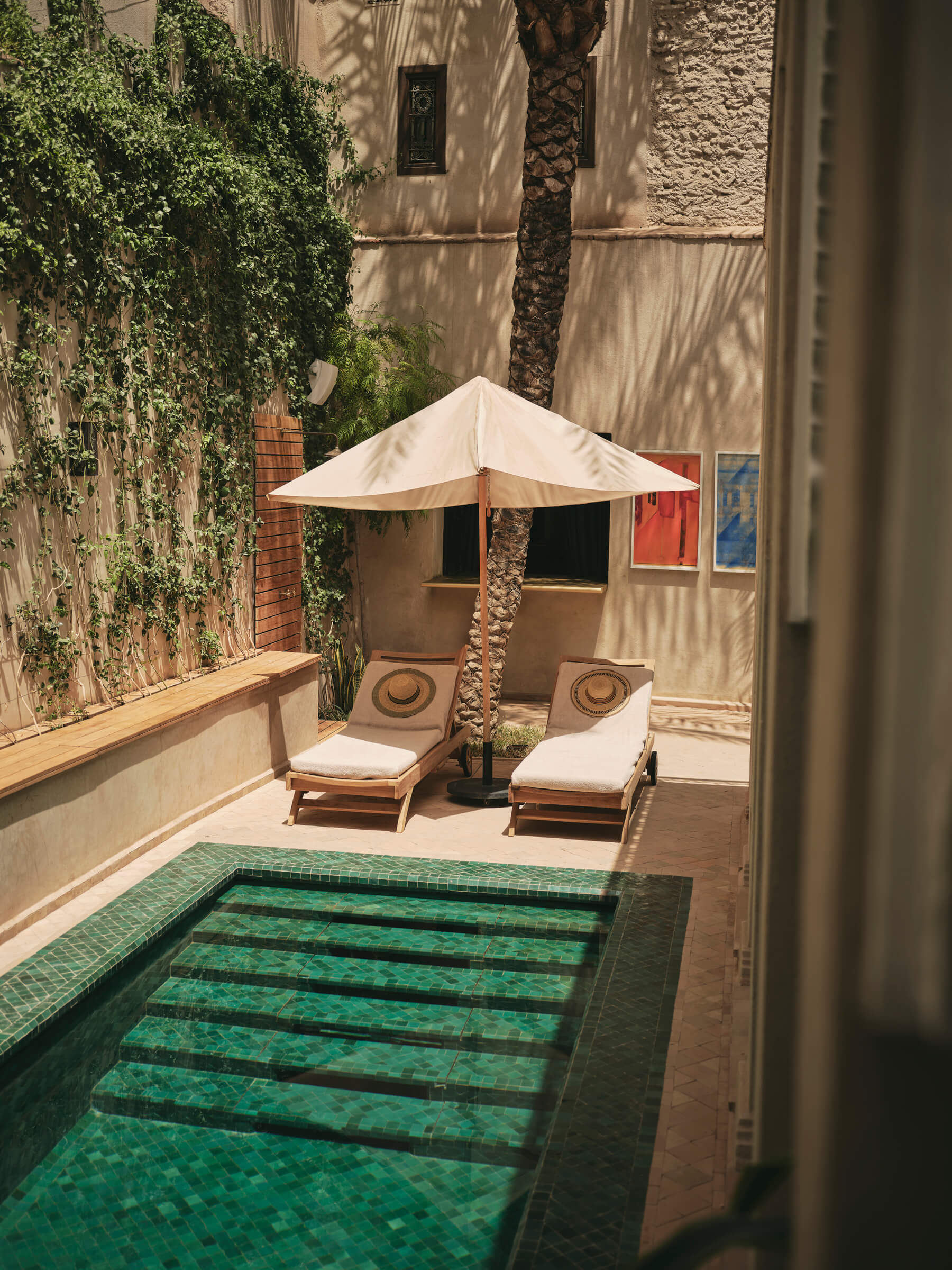
Outside the hotel itself, landscape architect Elli Pangalou's gardens provide additional layers of experience. A lily pond with sun loungers and a star gazing deck. A hilltop lounge area with fireplace for evening gatherings. An outdoor cinema in summer. Wooden walkways that follow the terrain rather than forcing it flat. Everything feels considered, not imposed. Summers are green and mild, with genuinely cool nights even in August. Autumn brings fog that moves through the forest like it has intention. Winter brings proper snow, working fireplaces throughout the hotel, and an atmosphere you cannot manufacture. It is the opposite of coastal predictability. The architecture frames this without fighting it. Windows are positioned to slice the forest into compositions. Public spaces open toward the slopes instead of closing inward. Exterior circulation respects the mountain rather than trying to dominate it. Everything feels placed, not imposed. This is where Manna stops being theoretical and starts competing with Santorini or Mykonos on completely different terms. The experience is not about sun or sea. It is about mood, altitude, weather that shifts daily, and access to a version of Greece that feels genuinely undiscovered even though it has been here the entire time.
Where award winning chef Athinagoras Kostakos builds menus around what Arcadia actually produces rather than what trends well
Manna avoids the tired clichés of mountain cuisine and equally avoids the kind of trend chasing fine dining that ages badly within two years. Instead, the restaurant, led by award winning Greek chef Athinagoras Kostakos, works directly with Arcadian producers and Greek suppliers to build menus based on what the region actually grows and what the season actually offers. Expect high altitude ingredients, forest herbs, slow cooked meats that make sense at elevation, handmade pastas, regional cheeses and cold cuts, clean Mediterranean vegetables, honest plating, and execution that feels confident without needing to prove anything. The breakfast is exceptional, with a small buffet that changes daily, featuring handmade pies, exceptional local cheeses and cured meats, freshly baked breads, jams and honey from nearby producers, and made to order dishes. Coffee is roasted specifically for Manna at a neighbouring artisanal roastery. The bar leans into the building's sanatorium past with a layout that references old apothecaries without becoming costume design. A well curated selection of malt whiskies and spirits, both international labels and bottles from Greek artisan producers, all served with views across the forest. This is the version of Greek hospitality that rarely gets written about. Serious cooking without theatrics, delivered at a level that supports the architecture instead of trying to steal the spotlight. You will not find the over designed drama of island tasting menus here. What you will find is food that makes sense for a hotel built at 1,200 metres, designed for travellers who care more about whether something is good than whether it photographs well.


Why the wellness hub feels more like genuine restoration than another luxury spa trying to sell you products
Retreating to the lower level, the Manna Wellness Hub offers something genuinely different from the standard luxury spa template. The centrepiece is a pool designed to look like a cave, with skylights overhead letting in shafts of daylight that move across the water's surface as the sun shifts. It feels subterranean, almost spiritual, and can be booked for private use in the evening. Two treatment rooms offer bespoke rituals developed in collaboration with CODAGE Paris, along with warm and cold stone massages and other treatments designed for deep restoration. The sauna and hammam provide both indoor and outdoor options, allowing guests to move between heat and the mountain air. A fireplace warmed yoga room offers space for meditation, Pilates, and functional training. The gym replaces plastic and chrome with timber and natural materials, keeping the aesthetic aligned with the rest of the property. Everything operates on geothermal energy, minimising environmental impact while maintaining heating and cooling throughout the year. The hotel has committed to chemical free cleaning products, refillable amenities, and sourcing from local organic farms. Even the slippers in rooms are made from recycled plastic bottles. Eighty five percent of the team comes from the surrounding area, and Manna actively supports local heritage projects. This is not a spa where wellness feels performative or packaged. It is a space that genuinely encourages restoration, built into a mountain, surrounded by forest, designed for guests who understand that real recovery requires more than a massage menu.
How Manna proves that Greek luxury no longer needs to depend entirely on the coastline to compete globally
The significance of Manna has nothing to do with novelty. It has everything to do with possibility. For decades, the luxury conversation in Greece has been owned entirely by island destinations. Manna disrupts that not by being alternative or niche, but by proving that interior Greece has equal potential when someone is willing to take it seriously. Within its first year of operation, Manna has accumulated accolades that confirm this shift: Second Best Hotel in the World at the AHEAD Global 2024 awards, First Prize at the CREATEURS DESIGN AWARDS 2025 for Best Hospitality Project Interior Design, First Prize at the ARCHELLO Hotel Building of the Year Award, First Prize at the MUSE AWARDS for Interior Lighting, and First Prize for Building of the Year and Historic Building Restoration at the Grail Awards 2025. These are not small regional wins. They are global acknowledgements that mountain hospitality in Greece can compete at the absolute highest level. This is not alternative Greece. It is Greece treated with the same respect and investment the islands have received for years. A version of the country defined by mountain air, forest density, weather systems, and a building that has survived nearly a century without apologising for what it is. Manna does not exist to replace the islands. It exists to expand what Greece can offer at the luxury level. For travellers who have already done Santorini three times, already photographed every sunset angle, already moved through the familiar rhythm of coastal resorts, Manna becomes a genuinely new reference point. The hotel welcomes children aged eleven and over, positioning itself firmly for guests seeking a more contemplative, adult focused experience. It offers silence instead of scenes. Weather instead of views. Stone instead of whitewashed render. And a level of depth you cannot manufacture on a coastline no matter how much money you spend. Most luxury hotels in Greece depend entirely on the sea. Manna proves the mountains are more than enough.